
AI May Be Digital —
But Its Infrastructure Constraints Are Physical and Familiar
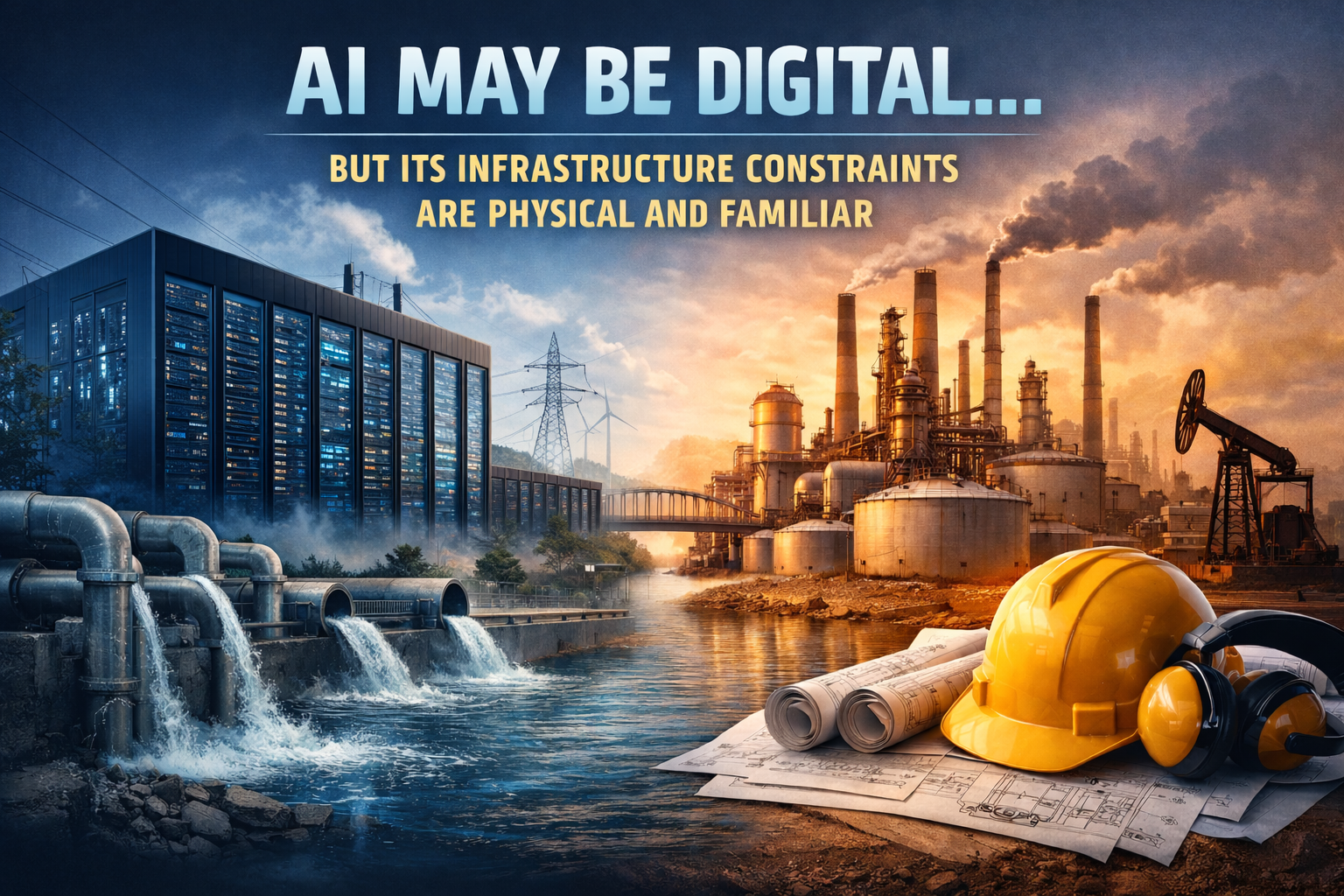
As artificial intelligence accelerates and data centers expand across the country, many of the debates unfolding today feel strikingly familiar.
- Water consumption.
- Power demand.
- Noise.
- Community impact.
For those of us who have spent time in heavy industry, these conversations are not new.
Long before hyperscale computing entered the public conversation, process industries like oil and gas operated under similar pressures — managing scarce resources, optimizing energy use, mitigating environmental impacts, and earning the trust of the communities in which they operated.
It may be the process engineer in me, but as I read more about the rapid growth of data center infrastructure, I see challenges that closely resemble those I encountered earlier in my career as a chemical engineer in the oil and gas industry.
My work began in St. Croix and later took me around the world as a researcher and problem solver, addressing operational questions in facilities where reliability, safety, and efficiency were not optional — they were foundational.
As communities raise concerns about data centers "near you," it's worth examining several of the most common objections through the lens of lessons learned in mature infrastructure sectors.
Water — The Most Visible Concern
Consider water — perhaps the most visible concern. Cooling large server clusters can require significant volumes, and communities understandably question the sustainability of drawing from local supplies.
In oil and gas, similar pressures led to continuous improvement programs that expanded water treatment, reuse, and recycling, dramatically reducing reliance on freshwater sources. Over time, many facilities moved toward circular water management — treating water as a resource to be managed rather than consumed.
Data centers can adopt — and even advance — this approach by designing facilities with robust onsite treatment and recycling systems that move toward closed-loop cooling wherever feasible.
Energy Demand
Data centers are large and growing consumers of electricity, but heavy industry has long operated under comparable constraints. Refineries and processing facilities learned to capture value from thermal energy through waste heat recovery, steam systems, and cogeneration — producing power onsite while improving overall efficiency.
As AI workloads continue to grow, similar approaches could allow data centers to reduce strain on the electric grid, enhance resilience, and operate more flexibly — including enabling siting in more remote locations where power availability is a limiting factor.
Noise and Community Impact
Noise is another recurring concern for neighboring communities. Early in my career, one of my first assignments as an intern in Beaumont, Texas was evaluating plant noise and recommending mitigation strategies with clear cost justification.
Industrial operators have spent decades refining solutions such as acoustic insulation, equipment design improvements, and buffer zones. Data centers have the advantage of incorporating these considerations during early design phases — addressing concerns proactively rather than reactively.
The Social License to Operate
Underlying these technical considerations is a broader lesson: rigorous industrial risk management. Oil and gas developed structured approaches to identifying hazards, assigning responsibility, and continuously improving performance in complex operating environments.
Equally important are the softer — but no less critical — elements of maintaining a social license to operate:
- Early community engagement.
- Transparency.
- Environmental stewardship.
When these factors are overlooked, projects often encounter delays, opposition, or regulatory friction — dynamics increasingly visible in discussions around new data center development.
What This Means for Site Selection and Infrastructure Strategy
As artificial intelligence continues to scale, the expertise required to build resilient digital infrastructure extends beyond software engineering or traditional real estate development. Field operators, process engineers, and practitioners from established industries bring valuable perspectives on lifecycle planning, energy integration, and operational discipline.
Concepts such as cogeneration, microgrids, and reliability engineering can help data centers achieve higher uptime, faster deployment, and more adaptive siting strategies.
From a site selection and infrastructure strategy perspective, one reality is becoming increasingly clear: access to reliable power, sustainable water management, and strong community alignment are becoming decisive factors in where and how data centers are developed. Thoughtful planning at the intersection of engineering, real estate, and stakeholder engagement will shape a better phase of digital growth.
As we plan for the next wave of digital infrastructure, the path forward will require more than innovation alone. It will demand the practical wisdom of industries that have long operated under physical constraints — managing finite resources, balancing community expectations, and designing systems for reliability over decades, not quarters.
By integrating engineering discipline with thoughtful site selection and proactive engagement, we can build data infrastructure that earns public respect while enabling technological progress.
Because in the end, the future of AI will be shaped not only by advances in computing, but by how responsibly we manage the systems that support it —
AI may run on silicon, but its success still depends on water, energy, and trust.
I'm curious whether others are seeing stronger collaboration between emerging AI infrastructure and established industrial sectors — what are you observing?